Here is a story for another time. It begins a few months earlier and ventures into the year 2084.
Filmmaker Casey Neistat once remarked that sleep can be replaced with exercise. Instead of sleeping 8 hours, he suggested waking up 2 hours earlier to go running. I prefer to phrase it differently: running can make you feel better when you are sleep-deprived. So on the weeks when I sleep 5 to 6 hours a night, going out for a run calms my nerves and clears up my mind. Sometimes I like to go for harder runs, other days a softer jog.
Lately, I’ve been enjoying podcasts during my longer runs, usually listening to shows such as Radiolab, 99% Invisible, Song Exploder, and Imaginary Worlds. These podcasts tell stories that range from the intellectual, to the creative, the innovative, and the emotional. It’s a great way to lose myself in another world when I’m running for several hours – and especially so when I am literally lost during a run.
But that is a story for another time.
One recent podcast episode talked about EVE Online, a massive multi-player game with an economy that has been compared to small countries (both for scale and for theory). EVE Online is set in a virtual universe and has its own monetary system. The in-game currency, known as ISK (InterStellar Kredit), can be bought with real-world money based on a live exchange rate. Players spend ISK to boost their avatar’s lives, purchase virtual weapons, and even build space battleships that are said to span the size of entire real-world suburban neighborhoods. Just one of these virtual warships can cost several thousands of real US dollars.
Because similar to the real world, a damning amount of money is spent on virtual wars.
And so the podcast told a story of how several fleets of virtual spaceships, worth hundreds of thousands of real American dollars in all, were destroyed on a single fateful day in January 2014, during a battle known as the Bloodbath of B-R5RB. The clash was part of a larger conflict between American video gamers and “The Russians”, for inter-galactic domination! (Cue the “muahaha” evil laugh).
In the end, the Americans won the larger war, in part because the opposition had imploded. “The Russians” were actually a collection of gamers from different Eastern European countries; their downfall coincided with the timeline of the Crimea crisis, during which Ukrainian gamers began sabotaging the cyber lands of their Russian (actual Russians) allies while, outside their computer screens, the Russian Federation was conducting a takeover of Ukraine’s Crimea.
Imagine that: the fate of a video game decided by real-life current events!
The podcast had made me curious about what it means to be headed towards a reality that’s sharing an expanding grey area with virtual worlds. Will we one day forget the line that separates the two? Worst yet, could we forget that technology is built from reality, and not the other way around?
So then I also imagined a world flipped, one where the computerized space is deciding the fate of reality itself. Perhaps the next major economic disaster will stem from provocations to digital currency systems. Or maybe today’s tech corporations will eventually replace the political structures of nation-states. Internet access might be added as a basic human right, placed right next to the fight against hunger and poverty. What if you could no longer buy groceries unless you had an Amazon account linked to your Bitcoin savings?
Introducing 2084: The futuristic version of Winston and his Big Brother!
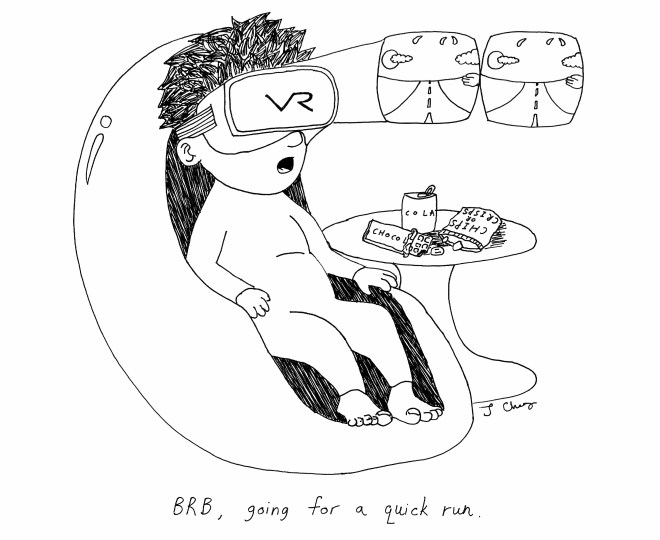
Jump to a few weeks after that long run. I am on a plane flying from New York to London. I turned on my Amazon Kindle and tapped on “Ready Player One” by Ernest Cline, a novel I’ve been meaning to read before Spielberg’s film adaptation gets released. I immediately became absorbed in the story, which is set in a dystopia where everyone finds their escape from the broken world via a virtual reality game known as OASIS. The OASIS universe is depicted as a far better place, with free education, glamorous dance clubs, unlimited resources and even giant mech robots!
But as fun as the book was to read, the story reminded me of how easily digital space can become the primary reality for people. The plot was centered on people living out entire lives via a virtual universe, and somehow this fantasy land didn’t seem so foreign. Does that mean we are on a trajectory towards such a reality? (Insert dramatic music here.)
In the end, both the podcast and novel led me to wonder: just how aware are we of technology’s evolution? Social media and smart phone apps are no longer the novelty items that we used to play with to take a breather from the real world. Instead, they are intertwined into every day life. Myspace was great for personalizing a digital profile, but Facebook has flourished by personalizing the news content that we check first thing each morning. How dramatically technology has transformed in just one decade.
Finally, back to my run. It was a slightly longer session because I did actually get lost. After three hours of running on gravel roads and concrete bridges, I pulled out my phone to check the stats recorded by my running app. Just as I tapped the “Finished run” option, the application unexpectedly restarted itself and to my horror had erased all traces of the run! Gone were my mile splits, average pace, and estimated calories burned.
So, in a bout of tepid humor, I texted my friend, “If the app doesn’t show it, did I even run?”
But again, a story for another time.
Sources:
https://www.imaginaryworldspodcast.org/world-war-eve.html
http://reason.com/archives/2014/05/07/a-video-game-economy-the-size
https://www.wired.com/2014/02/eve-online-battle-of-b-r/
https://www.youtube.com/watch?v=DRe9DBosLD4
“Ready Player One” by Ernest Cline
And “Thank you!” to an individual who introduced me to some wonderful podcasts

 jackynotes